The United States said that it is imposing ‘severe’ economic sanctions on Russia in response to President Vladimir Putin’s attack on Ukraine, aimed at crippling the Russian economy, its financial institutions and its access to technology.
US President Joe Biden at the White House Thursday said: ” Putin chose this war. And now he and his country will bear the consequences.”
The signing comes a few days after a presidential media aide, Femi Adesina, assured that Mr Buhari will assent to the bill.
Before he signed it, the president sought an amendment to the bill by asking the National Assembly to delete Clause 84(12) of the bill.
The clause reads, “No political appointee at any level shall be a voting delegate or be voted for at the Convention or Congress of any political party for the purpose of the nomination of candidates for any election.”
The president said the Clause constitutes a disenfranchisement of serving political office holders from voting or being voted for at conventions or congresses of any political party, for the purpose of the nomination of candidates for any election in cases where it holds earlier than 30 days to the national election.
The Section, he said, has introduced qualification and disqualification criteria that ultra vires the Constitution by way of importing blanket restriction and disqualification to serving political office holders of which they are constitutionally accorded protection.
“The practical application of section 84(12) of the Electoral Bill, 2022 will, if assented to, by operation of law, subject serving political office holders to inhibitions and restrictions referred to under section 40 and 42 of the 1999 Constitution.
“It is imperative to note that the only constitutional expectation placed on serving political office holders that qualify, by extension as public officers within the context of the constitution is resignation, withdrawal or retirement at least 30 days before the date of the election.ⓘ
“It will be stretching things beyond the constitutional limit to import extraneous restriction into the constitution on account of the practical application of section 84(12) of the bill where political parties’ conventions and congresses were to hold earlier than 30 days to the election.
“…with particular regards to the benefits of the Bill, industry, time, resources and energy committed in its passage, I hereby assent to the Bill and request the Nationally Assembly to consider immediate amendments that will bring the Bill in tune with constitutionality by way of deleting section 84(12) accordingly,” he said.
Mr Buhari who disclosed that he received inputs from relevant MDAs after thorough reviews of the bill and its implications to Nigeria’s democratic processes, said it contains salient provisions that could positively revolutionise elections in Nigeria through the introduction of new technological innovations.
These innovations would guarantee the constitutional rights of citizens to vote and to do so effectively he adding that it would improve the effectiveness and transparency of the election process.
History of rejections
The National Assembly had in January, transmitted the reworked version of the bill to the president for assent, after the latter half rejected it five times – citing reasons that ranged from cost of election, insecurity, drafting errors to proximity to the date of elections.
In the newly signed bill, the lawmakers had addressed an issue raised by the president – the mode of primaries for which political parties will conduct primary elections to elect candidates for political offices.
The new law provides political parties the have the option of using direct, indirect or consensus modes of primaries.
It also provides for the use of electronic voting and electronic transmission of results.
Many individuals and civic groups, who have called for electoral reforms have, said the law will ease electoral processes and promote fairness and credibility in future elections.
Good journalism costs a lot of money. Yet only good journalism can ensure the possibility of a good society, an accountable democracy, and a transparent government.
For continued free access to the best investigative journalism in the country we ask you to consider making a modest support to this noble endeavour.
By contributing to PREMIUM TIMES, you are helping to sustain a journalism of relevance and ensuring it remains free and available to all
President Muhammadu Buhari on Thursday paid a visit to Sokoto State and commissioned a cement plant by manufacturing company, BUA Group.
Hosted by Sokoto State Governor Aminu Tambuwal, President Buhari at the event inaugurated the three million metric tonnes per annum plant and 48 Megawatts power plant.
President Buhari lauded the company for believing in Nigeria and being the largest employer of labour in the northwest region of the country.
The President also expressed delight that the Federal Government policies on economic diversification, job creation, and creating an enabling environment for businesses to thrive are working. He pledged that his administration would continue to support serious investors to set up businesses that will take advantage of huge reserves of resources in different parts of the country.
He recounted that in 1985 as the then Head of State, he was at the same location to commission the 2nd line of the facility.
”Today, almost thirty-seven years later, to commission the fourth line is a very special day for me personally.
”As you all know, one of the key economic pillars of our administration has been to create an enabling environment for businesses to thrive. This is necessary for job creation and indeed, for our economy and national security.
”In the past few weeks, I visited Ogun and Kaduna States where I observed many private sector investments in action. And today, I am here in Sokoto to commission this multi-billion Naira project.
”It is therefore very clear for all to see that our policies are working. Progress is gradually being made in all parts of the country,” he said.
The President thanked the Founder of BUA Cement, Abdul Samad Rabiu, and the entire team for the great work they are doing in supporting the government’s economic diversification and job creation agenda.
He noted the company, which has completed four new cement plants of similar capacity in the last five years in different parts of the country and is set to complete two more plants soon, had shown through these investments that they believe in Nigeria and its potential.
Commending BUA and other entrepreneurs for making Nigeria self-sufficient in cement and a net exporter of the strategic product, the President said: ”I am pleased that through these investments, BUA Cement has created employment opportunities for our citizens. Today, BUA is the largest employer of labour in the North-West region.
”I always remind Nigerians that every region, indeed every State, in Nigeria sits on huge reserves of resources. For example, in this area, Kebbi, Sokoto and Zamfara can boast of rice production, gold and other precious metals development and of course, heavy industries like cement manufacturing.
”As a Government, we introduced policies and mechanisms to support such investments in a legal, ethical and inclusive manner.
”We remain prepared to support serious investors to set up businesses that will take advantage of these opportunities through value addition so as to take advantage of the huge market here, as well as in the greater African region and the world at large,” President Buhari said.
Highlighting other efforts to bring even development to all parts of the country, the President expressed confidence that the Ajaokuta–Kaduna–Kano (AKK) gas project, when completed, will bring gas for domestic and industrial purposes from the South South region to the South East, North Central and North West Geopolitical zones.
He said the AKK project would significantly reduce cost of operations for industries in the regions.
On security, President Buhari reiterated his commitment to bring peace and stability to all parts of Nigeria, listing a raft of measures undertaken by this administration to ensure that normalcy returns to the country.
Abdul Samad Rabiu, Chairman, BUA Cement, who commended the President for creating the enabling environment for businesses to thrive, acknowledged the support of the Central Bank of Nigeria (CBN) and its Governor in setting up the gigantic project.
He announced that ”so far, we have invested over a billion dollars in the past four years and we urge the CBN to continue to support industries like ours that use locally sourced raw materials to add value.”
He pledged that BUA would continue to invest more in the cement industry until Nigeria is self-sufficient and the commodity is made available, accessible, and affordable for all Nigerians.
”In the past 6 years, we have completed 4 plants – two in Obu, Edo State and two in Sokoto (of which this Sokoto line 4 is the fourth) with BUA’s total production capacity now standing at 11.5million tonnes with the completion of this plant.
”Next year, we intend to complete the construction of two new plants of 3 million metric tonnes each for which construction is ongoing – one in Edo and the other, here in Sokoto.”
The Chairman of BUA said he looked forward to President Buhari commissioning these plants next year which will bring total production capacity to 17.5million metric tonnes.
Dignitaries at the event include the Sultan of Sokoto, Sa’adu Abubakar; the Ooni of Ife, Adeyeye Enitan Ogunwusi; the CBN Governor, Godwin Emefiele; Chairman BUA Group, Abdul Samad Rabiu, among others.
BUA Chairman, who according to Forbes is the fifth richest man in Africa, appreciated the President for his presence at the event.
He explained that 95% of the materials used in production in the company are locally sourced
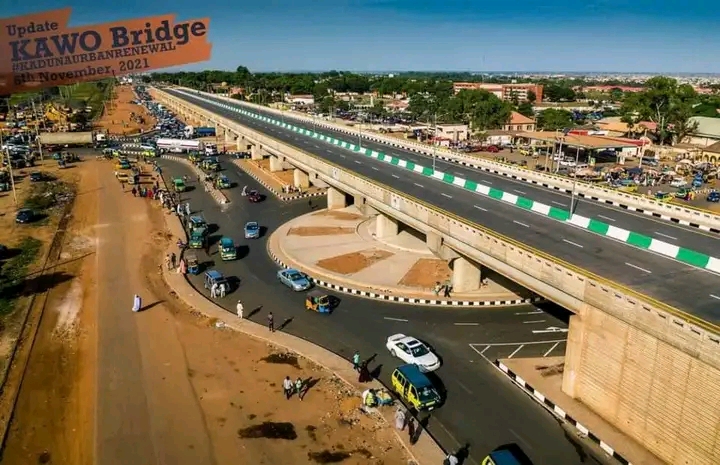
President Buhari Commissions Bridge Where He Was Almost Killed In 2014 By Boko Haram
null
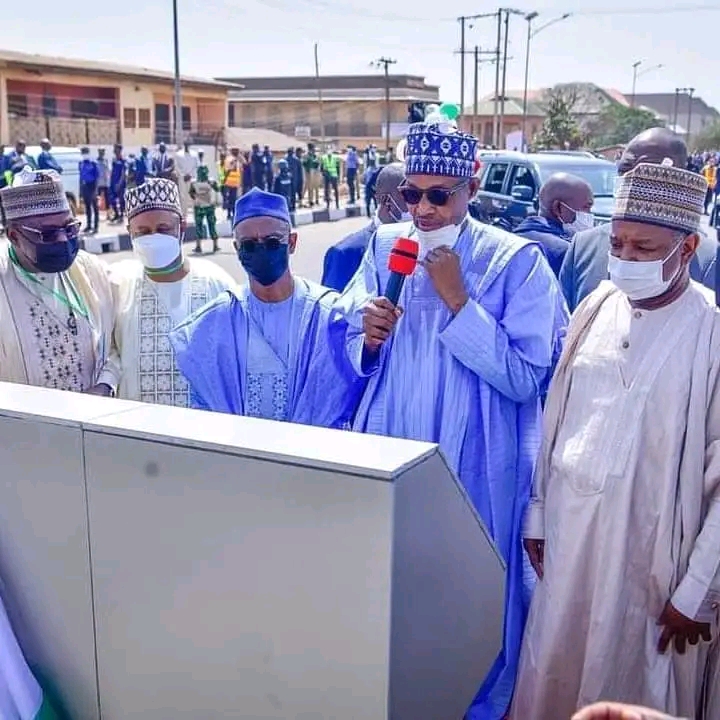
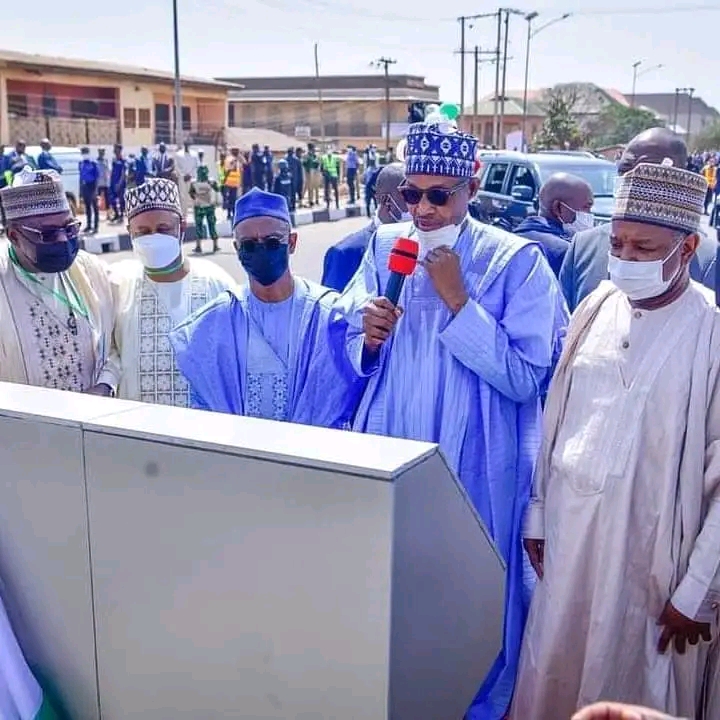
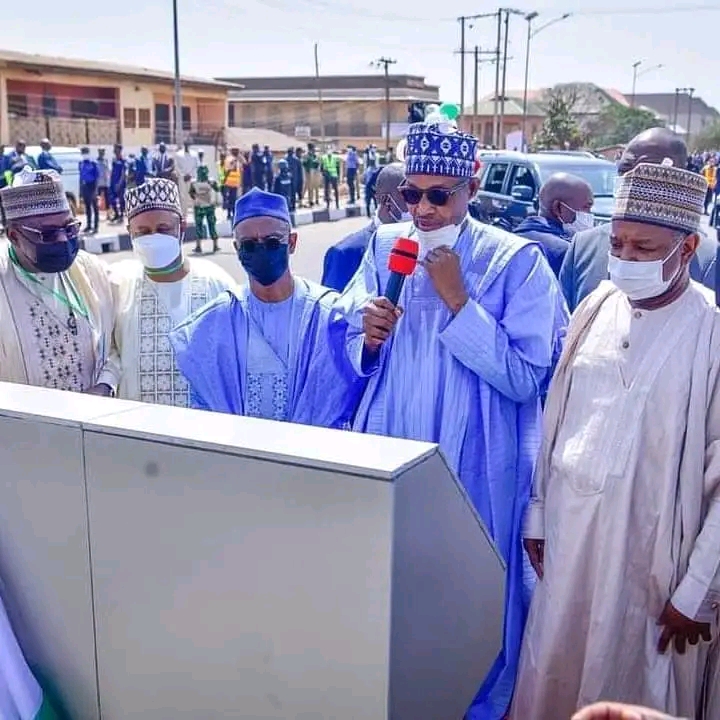
President Muhammadu Buhari has commissioned a bridge in Kaduna in an area where he was almost killed by Boko Haram terrorists.
The President, at the time an aspirant, was caught in an explosion at the busy Kawu market area.
Although he escaped unhurt, his vehicle, a Toyota Land Cruiser, and another one behind it were badly damaged, reports at the time said.
During the commissioning of the Kawu Bridge on Thursday, Governor Nasir El-Rufai recalled the incident.
“It is my great honour and privilege, Mr President, to bring you to the Kawu Flyover. Mr President will recall this bridge very well because it was just under this bridge that Boko Haram tried to kill you,” the governor said at the event.
“By the grace of God, you are still alive, you are with us and God preserved you so that you will lead us and inspire us to do some of what we are doing.”
While responding, Buhari, who is on a two-day visit to the northwest state to commission some projects, thanked God for sparing his life.President Buhari said his government is committed to handing over a better country. Photo: Twitter@GovernorKaduna
He recalled how the terrorists “wanted to blow me but my escort somehow stopped them”.
“I have lived in Kaduna for many years; I am very much aware of this route. I would not recall how much I crossed it and you told me how there was an attempt on my life on this route,” Buhari added.
A Better Nigeria
Aside from the commissioning, Buhari also visited the palace of Alhaji Muhammadu Isa 11, the Emir of Jama’a, where he reiterated his commitment to tackling insecurity.
According to him, his government has made tremendous strides in fighting insecurity in the northeast.
“If Nigerians want to be fair to this administration, they should find out on what we campaigned for in 2015 and 2019. The security situation then, where we are now, and what we hope to hand over in 2023.
“If you want an honest report, try and ask people from the northeast, especially from Borno State,” he said.
Buhari noted that he hopes “to hand over a better Nigeria than the one we inherited”
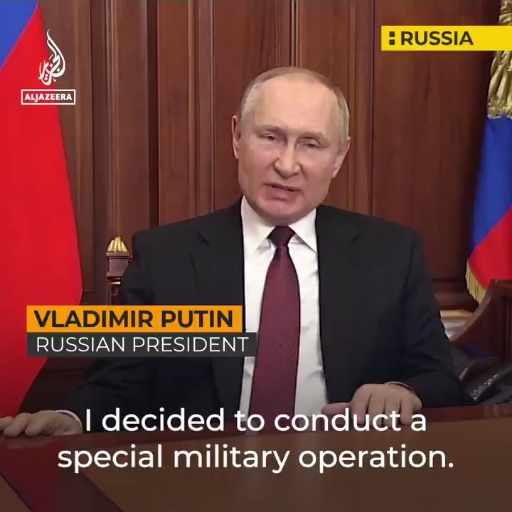
Russia-Ukraine war: Putin warns of severe consequences if foreign powers interfere
As the war between Ukraine and Russia puts the world on edge, Vladimir Putin, Russia’s president, has warned global leaders against actions that will stop Russia’s operation in Ukraine.
Putin said any interference will attract immediate response that will lead to consequences they have “never faced in their history,” adding that Russia was ready for any outcome.
TheCable had reported that Putin ordered a special military operation in Ukraine’s Donbas region on Thursday.
Ukraine’s interior ministry said Russia had begun attacks on the country, as explosions were reportedly heard in Kyiv, Kharkiv, Kramatorsk, and in other parts of Ukraine.
The attacks were said to have targeted key infrastructure in the country.
US President Joe Biden condemned the attacks, describing them as unprovoked.
He said Putin has chosen a “premeditated war that will bring a catastrophic loss of life and human suffering”
He said the US and its allies—members of the North Atlantic Treaty Organisation (NATO)—will deliver a decisive response.
But Putin, in a TV broadcast, said the circumstances required firm and immediate actions as Donbas’ People’s Republic asked for help from Russia.
He warned that Russia will respond swiftly to any attempt to disrupt its operation in Ukraine.
“In this regard, according to the Article 51, part of the Unted Nations Charter, with the consent of the Russian Federation Council, and in accordance of the ratified agreement on February 22, of this year on friendship and mutual aid with Donetsk People’s Republic and Luhansk People’s Republic, I decided to conduct a special military operation,” he said.
“Its goal is the protection of people, who during eight, suffered from abuse and genocide from the Kyiv Regime.
“Whoever would stop us, and further create threats to our country, to our people, should know that Russia’s response will be immediate and lead to such consequences that you have never faced in your history. We are ready for any outcome.”
Nigerian govt takes delivery of final batch of Tucano jets
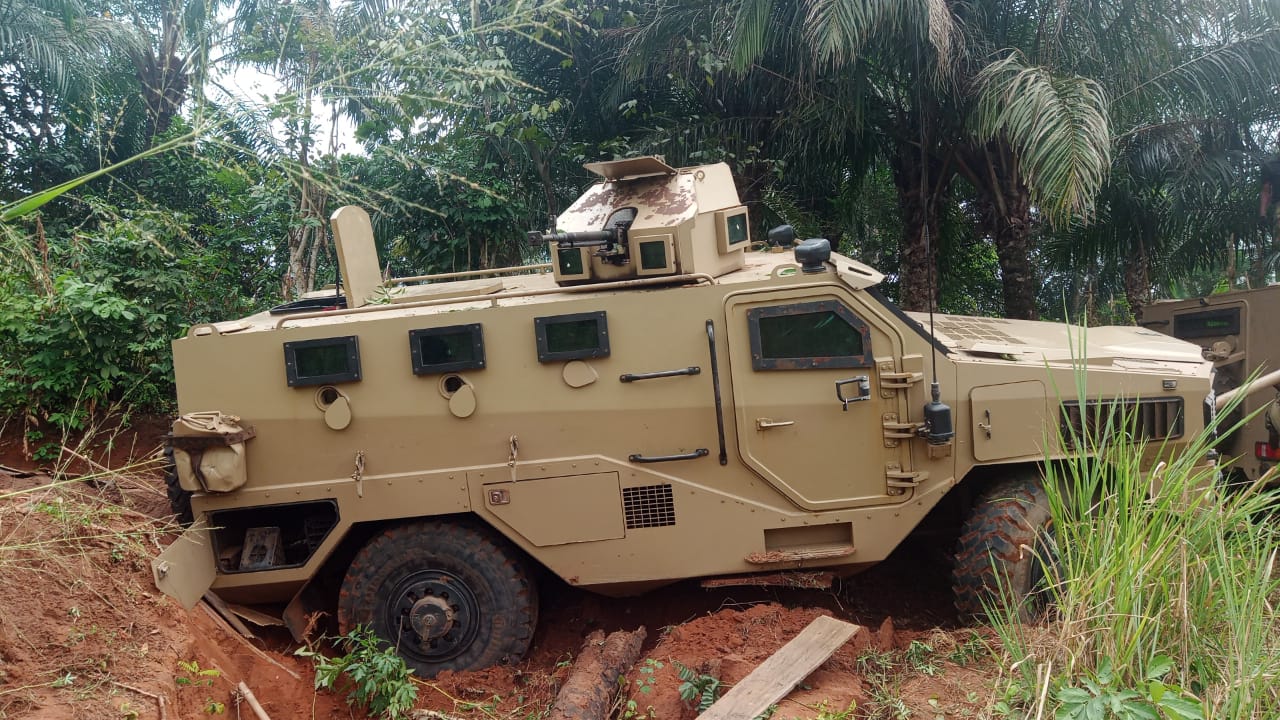
The federal government says it has taken delivery of the final batch of the 12 A-29 Super Tucano fighter jets expected from the United States.
The Minister of Information and Culture, Lai Mohammed, disclosed this on Monday when he featured on a phone-in programme of TV Continental, “This Morning,’’ monitored by the News Agency of Nigeria (NAN).
“All the 12 Super Tucano fighter jets have been received. As at this morning, all the 12 were here and they have been deployed to the North-east.
“We can see that the Tucano jets are actually game changers.
“Most of the successes we have recorded in recent times is because of the acquisition of new platforms, not limited to the super Tucano,’’ he said.
The minister said with the recent notable successes recorded by the military on insecurity, he was amused by a story on Monday that the Nigerian Air Force paid N20 million to bribe bandits so that they would not bring down the president’s aircraft.
“Fortunately, the Air Force immediately debunked this because this exposes their ignorance.
“Between Zamfara, Katsina, parts of Kaduna and Niger states, there are about 150 bandit camps. Who then was the money given to?
“It does not make any sense and it is because they do not understand how bandits operate that is why they can peddle that kind of fake news,’’ he said.ⓘnull
Mr Mohammed said with the ‘improved’ security situation in the North-east and North-central zones the nation would experience improved food security.
“If you observe what is happening , you can see heightened activities in the agricultural area.
“This is because of the superior fire power of the military which is now making it possible for people to go to their farms, especially in the North east.
“They have been able to put the criminals at bay,’’ he said.
The minister gave an assurance that the success of the military against terrorists and bandits would be sustained.
He therefore solicited the cooperation and support of Nigerians for the sustenance of the military action.null
The Nigerian Air Force on July 22 took delivery of the first batch of six of the A-29 Super Tucano aircraft from the United States.
The Director of Public Relations and Information, NAF Headquarters, Edward Gabkwet, who made the announcement, said the aircraft arrived in Kano.ⓘnull
The officials that received the aircraft included the Minister of Defence, Bashir Magashi, Chief of Army Staff, Faruk Yahaya and Chief of Air Staff, Oladayo Amao.
SPECIAL REPORT: More Nigerians live in fear as kidnap-for-ransom worsens (II)
In 2020, 937 people were kidnapped in Kaduna State alone, according to a government report documenting only reported cases. And in the first quarter of 2021, 949 persons were kidnapped, again as reported by the government.
The second part of our deep-dive into the kidnap-for-ransom ‘industry’ in Nigeria uses data to show that kidnappings have been on the rise annually since 2018 across Nigeria. Read the first part of the report here.
As dusk fell on the second day of January this year, apprehension gripped Kaya as over 50 motorcycles, each carrying three men wielding AK-47 rifles, stormed the community. Then there were loud bangs from guns before buildings and vehicles went up in flames.
The attack left 11 persons dead and nine others with bullet wounds. The pictures that emerged from the attack are extremely gory and cannot be published for ethical reasons.
That attack was a return fight. The previous day, January 1, men in Kaya in Giwa area of Nigeria’s northwestern Kaduna State had confronted the gunmen, who had come to kidnap for ransom. In a rural context, where government is far removed, the men were already accustomed to mobilising themselves against armed attacks.
But their efforts were not successful. Despite losing their leader, Shamsu Umar, to the resistance, the invaders kidnapped an unspecified number of persons, including two women, according to records reviewed by PREMIUM TIMES.
“The bandits don’t want resistance when they attack a community to kidnap residents for ransom,” said Abdulaziz Abdulaziz, a journalist, who has had rare access to interview some of the bandits in their enclaves. “When they are resisted or they lose a member, or they are attacked by the vigilante or the military, they re-mobilise to sack the community.”
Kaya lies close to Hayin Kaura community in Katsina State’s Dandume area, where 80 Islamic school pupils were kidnapped in December 2020.
The attacks, which officials and the media loosely call banditry, have crumbled the world of Nigeria’s northwest, stalling progress against the region’s longstanding education sector crisis with repeated mass abductions of students at schools.
The January fate of Kaya is what several other communities across the Northwest, which has now become Nigeria’s kidnapping hotbed, have endured and it mirrors a pattern: invading communities to kidnap some “valued” residents and forcing families to raise money for ransom. If they are resisted, the bandits would re-arm and return to sack a community.ⓘ
“It all started with the collapse of the Fulani economy,” said the Commissioner for Home Affairs and Internal Security in Kaduna State, Samuel Aruwan. “This is that a Fulani man, with a dozen children, all dependent on cattle, wakes up one morning and finds that his animals have been rustled. He has no skill, he may not even be able to speak any language other than Fulfulde.
“With easy access to arms in the forest, he would decide to rustle another man’s cattle and it goes on like that. But at a point, they feel that why do they have to go steal cows when they can kidnap the owner and force his family to sell all the cattle to raise money for ransom?”
In the year 2020, 937 people were kidnapped in Kaduna State alone, according to a government report that documented only reported cases. And in the first quarter of 2021, 949 persons were kidnapped, again as reported by the government. The report did not say if the 39 students abducted on March 11 at the Federal College of Forestry Mechanization, Afaka, were included in the statistics.
By May 5, all the students had been released following a deal that officials told PREMIUM TIMES involved a prisoner swap. But while the Afaka students were in captivity, bandits struck at another Kaduna school, Greenfield University in Chikun area, abducting at least 23 students and staff on April 20. They demanded a sum of N100 million for their release.
But amid reiterated vows by Kaduna State Government not to negotiate with the kidnappers or pay them, the kidnappers killed three of the students and left their remains in Kwanan Bature, a location close to the university on April 23.
On April 26, two more students were killed, sparking a wave of outrage across the country. On May 1, one of the students was released following what is believed to be a ransom payment deal by the students’ parents. Others remained in captivity for several weeks before their families paid ransom to free them.null
In other cases of mass abduction at schools in the Northwest, 279 girls, said to be aged between 10 and 17 years, were abducted at Government Girls Science Secondary School, Jangebe, Zamfara State on February 26. That event mirrored a similar attack on December 11, involving over 300 students from a boys’ boarding secondary school in Kankara, Katsina State.
The mastermind of the Kankara abduction, Awwalu Daudawa, was killed in May after a gun duel with a rival gang. He had accepted an amnesty offered by the Zamfara State Government but decided to return to the forest where he was killed.
Apart from invading communities and schools to kidnap for ransom, bandits also lay siege to highways and undertake targeted operations, entering private residences to abduct individuals.
John Bala Gora, who is a community leader in Atyap Chiefdom of Kaduna State, was kidnapped from his Kaduna home after gunmen invaded his residence one late night in 2017, broke his arm and took him away.
“We walked in the bush through the night and what happened between my house and where we stopped in the morning was a hell of a beating,” said Mr Gora. “They kept beating me every night and said they were just interested in money.”
He did not disclose the amount, but he said his family paid a ransom to secure his release.
“I saw dead bodies,” Mr Gora added, recalling that his abductors told him those were the remains of their victims whose family could not pay the ransom. “But they said they also killed those whose families paid ransom, depending on what they just chose to do. Some of them also decided to kill me too but one of them saved me.”
Where bandits attack residences in urban centres, they work with information from urban residents, investigators familiar with arrested bandits told PREMIUM TIMES.Advertisements
“It is a sort of an industry with different linked roles,” one investigator said. “There are individuals in the cities and towns who identify targets and obtain valuable information on their movements to help the kidnappers. They get paid for the information they supply. The kidnappers or bandits are usually resident in the forests. They don’t know the urban residents and have to depend on individuals, like neighbours and security guards of targets, for information.”
The vast forests straddling the Northwestern states, from the Northcentral Niger State, have long been ungoverned and infested with massive arms, easily traded along cattle routes extending to Nigeria from neighbouring countries, our findings revealed.
“From Birnin Gwari, you can get to Zamfara through the bush,” said Mr Aruwan, explaining that arms could be moved across locations by criminals in the ungoverned space that the forests have become.
He told PREMIUM TIMES that a key part of the government’s response is to combat arms flow.ⓘ
Two suspected bandits held in custody in Kaduna, Umar Sule, 40, and Musa Sabiu, 35, told PREMIUM TIMES that they travelled to Zamfara State using a motorcycle along cattle routes from Kaduna’s Kachia area to procure a gun. They were arrested by the police just as they were about to cross to their settlement.
They said the gun was bought from one Rabiu, with whom they had operated as cattle rustlers in the Kankara area of Katsina State previously.
In the forests, PREMIUM TIMES learnt, bandits have to keep procuring arms to sustain their operations and protect themselves against rival gangs, vigilantes, and military strikes, thereby becoming hostage to gunrunners.
Apart from having to pay informants, proceeds from abductions mostly go to arms suppliers, our findings revealed, based on interviews with officials and persons with some understanding of the operations of the bandits.
But patrons also sponsor bandits with guns. Mr Gora said his abductors advised him to leave his work and “invest in us.”
He said, “I asked them what sort of investment and they said kidnapping business. They said I would only have to give them guns and ammunition and I would be getting a percentage from their operations.”
Based on our findings from interviews with officials, experts and survivors, the bandits are predominantly forest-dwelling Fulani herders who have now gone rogue.
But a Boko Haram splinter terrorist group, Ansaru, is also active in the northwest forests and has been involved in high profile abductions, officials told PREMIUM TIMES. Our reporter sighted highly disturbing photographs of the fatalities inflicted on the Nigerian security forces by the terrorist group. Ansaru is said to have recruited from rural Hausa communities.
As the kidnapping frenzy continues in the Northwest, emboldened bandits spread their activities to the neighbouring north-central state of Niger and communities on the fringes of Abuja, the country’s capital.
According to PREMIUM TIMES’s count of kidnapping in the media, an estimated 793 people were kidnapped in the North-central between January and May 2021. In 2018 the media only reported 24 kidnap cases in the region. The next year, only 30 cases were reported in the North-central. But the number rose to 135 in 2020 and 793 in the first five months of 2021.
According to the data, an overwhelming majority of the cases within the period (674) were in Niger State.
Other parts of the north
In Nasarawa State, the commissioner of police, Adebola Longe, in an interview with PREMIUM TIMES, said kidnappers were hiding the vast forests of the state.
“We would ensure that in Nasarawa State, there is no place for any criminal element, particularly the bandits to hide whether in the forest at Keyawu or Maraban Udege or Awe or Farin Ruwa or Nasarawa Eggon or Mada station or Eke in Doma local government,” Mr Alonge said.
Awyetu Jimba was kidnapped, alongside six other farmers, in early May on his way to the farm and taken to Zoni forest, another notorious hideout used by kidnappers in Nasarawa State. He and the other hostages were held for three weeks. He said they were fed once a day with yam their abductors stole from farms in the forest.
“The food was never enough. We walked far distances in the forest during the day and we rested at night. We slept on rocks and itchy grasses with mosquitoes, sometimes under heavy rain, as we changed locations daily until I was released,” he said.
Mr Jimba said his abductors tortured him daily as they grew impatient. He said the kidnappers originally requested a ransom of N5 million, but they eventually agreed to collect N3 million.
“My family was able to gather N3 million for my release with support and contributions from other members of my community,” he said.
The media reported fewer cases in the country’s Northeast, which is contending with the over decade-long Boko Haram insurgency. While Boko Haram is the primary kidnap culprit in the region, Yobe appears to be the kidnapping hotbed of the region with 112 cases reported between 2018 and May 2021.
Kidnapping in southern Nigeria
In the South-west, 264 people were kidnapped between 2018 and May 2020, according to media reports. Just like in other regions of the country, the data showed a drastic increase in the number of persons kidnapped in the region. The total number of people kidnapped in the region rose from 45 in 2018 to 92 by May 2021. Osun State with 50 persons kidnapped between 2018 and May 2021 and Ondo State with 99 persons kidnapped within the same period are the kidnapping hotbeds of the Southwest region.
The South-south used to report the highest number of kidnappings. Militants in Bayelsa, Delta and Rivers states targeted oil expatriates and pirates hijacked foreign sailors and their vessels for ransom.
While there are no official records of the frequency of kidnap incidents and the number of those kidnapped during the time, there appears to be a lull in the kidnap activities following the letup of militancy in the region.
However, the number of kidnap incidents in the region since 2018 is still a major source of concern. According to media reports, 341 persons were kidnapped in the region between 2018 and May this year. The data show that Delta, Edo and Rivers had the highest number of cases in the region with 73, 124 and 95 respectively.
The South-east recorded the lowest number of persons kidnapped of all six geo-political regions of the country with an estimated 77 persons kidnapped from 2018 to May this year.
The Nigerian military has since launched an operation to reclaim the forests of the North-west from the bandits. The governments of at least four states in the region have cut telecommunications networks, suspended weekly markets and restricted the movement of cattle and sale of fuel to support the operation.
Although initial reports indicated that the bandits were beleaguered and moving out of the area, latest reports indicate that they continue to attack rural communities in Zamfara and Sokoto states.
In the South-west, the six state governments have established a regional security outfit, Amotekun, to support the police in the fight against kidnappers. They also passed a law banning open grazing of cattle to check clashes between herders and crop farmers.
From Obasanjo to Buhari… how FG’s debt profile surged 658% to N26.9trn in 21 years
AUTHOR:Aderemi OjekunleJULY 31, 2021 11:22 PM
Nigeria’s public debt has been on the rise. Despite securing debt relief during the Olusegun Obasanjo-led administration, successive governments have continued on a borrowing spree — the federal government’s component of the public debt surging 658 percent to N26.9 trillion in the last 21 years.
This has raised concerns among Nigerians on the debt sustainability of the country amid dwindling revenue to meet the debt obligations to creditors.
Within two weeks, the senate approved three different loan requests by President Muhammadu Buhari.
Defending one of the loan requests, the Debt Management Office (DMO) said it is part of a borrowing plan for the 2021 budget.
“The proposed new capital raising is the new external borrowing provided in the 2021 Appropriation Act to part finance the deficit in the budget. In other words, the new capital raising has already been approved in the budgetary process by the executive and legislative arms of government,” the DMO had said in a statement.
As of March 2021, Nigeria’s total public debt has hit N33.1 trillion ($87.24 billion) — an accumulation of borrowings from successive governments, of which most were borrowed since the return to democratic rule in 1999. Advertisement
The overall public debt is the total debt accrued by federal, states, and the FCT from local and international lenders.
Of the N33.1 trillion, the federal government alone borrowed N26.91 trillion — this includes the FGN bonds, Sukuk, green bonds and Euro bonds.
Finally, after weeks of data aggregation, number crunching, dissecting and analyses of freedom of information (FOI) response from the Debt Management Office (DMO), TheCable presents findings that highlight how Nigeria’s aggressive borrowing defies its fiscal responsibility laws.
The analyses also include data from the DMO, National Bureau of Statistical (NBS), and fiscal papers from the Budget Office of the Federation.
FG DEBT CLIMBED 658% TO N26.9 TRILLION IN 21 YEARS
Data from the DMO seen by TheCable showed that federal government borrowings (local and foreign debt) climbed from N3.55 trillion in 1999 to N26.91 trillion at the end of March 2021 (the country’s latest official figure).
This represents a 658 percent increase in 21 years, comprising the administrations of Olusegun Obasanjo, Umar Musa Yar’Adua, Goodluck Jonathan, and the current Muhammadu Buhari.
HOW MUCH BUHARI BORROWED IN 6 YEARS
The Budget Office’s medium-term expenditure framework and fiscal strategy paper from 2015 showed that the Buhari-led administration incurred N7.63 trillion in domestic debt from June 2015 to December 2020.
Since the return of democracy in Nigeria in 1999, there has been clamor for the financial autonomy of local government councils as the constitutional third tier of government. In practical terms, the said third tier is almost non-existent as most of the State Governors have overtime, succeeded in transforming them to cash cows. As the journey progressed, three times the National Assembly (excluding the 9th) made attempts to amend the constitutional provision for the financial autonomy of the councils that were scuttled by the state governor’s rubber stamp Houses of Assembly. The State Governors, in most cases hide under the constitutional cover of Joint State/Local Government Account that is only beneficial to the State Governors. In democracy, it is common knowledge that power belongs to the people and not to just the people in power, who in most cases, are mere opportunists that can hardly describe what genuine democracy entails and what power to the people means. The implication is that the people, through their elected representatives at various levels of government, can hardly reflect their choices on issues of concern to them. This, in fact, is the dividing line between democracy and autocracy which we are partly practicing in Nigeria today. While democracy allows for the people’s will to prevail over personal interest by way of simple majority, autocracy solely allows whims of those in power to dominate governance space that beclouds the reasoning faculty of some politicians on the corridors of power to label their political party platforms as personal limited liability companies, that without their input, the democracy cannot grow. That is a dream of the absurd and an archaic thinking! It doesn’t require any extra labor to know that the biggest threat to democracy is the subversion of the people’s will by those in power which is now more pronounced than ever before. The moment elected representatives’ views begin to overshadow the people’s voices it is safe to assume that the journey to autocracy or any of its equally ugly variation has begun. Sadly, one thorny issue that has remained a concern to millions of Nigerians is the controversial local government council’s financial autonomy as Nigeria seems to be walking down that rough road repeatedly. The 1999 Constitution recognizes the existence of local government as the third tier of government after the Federal and State Governments. Since 1979, when the Decree established it as a system of government in the Constitution, the idea was to bring government closer to the people and ensure effective service delivery to the rural areas. To achieve this objective, several local government reforms were undertaken by different governments over the course of time. Essentially, finance and leadership recruitment process are key areas of concern in any discourse on local government financial autonomy. Incidentally, these are two areas that most State Governors are determined never to let go, even when the majority of their people are clamoring for freedom for the local governments. They prefer to make the maximum use of their management stooges imposed on the councils and the rubber stamp House of Assembly to scuttle the effort and their compromised representatives in the National Assembly that worship some of the governors for selfish interest. As at today, there are 768 local government areas and six (6) area councils recognized by the 1999 Constitution (as amended), making it a total of 774 local government area councils nationwide. By Law, these local governments and area councils are to be administered by democratically elected chairmen and councilors. Sadly, the State Independent Electoral Commissions (SIECs), directly under the watch and firm control of the State Governors, are the agencies saddled with the responsibilities of conducting elections for the councils’ executive and legislative arms. Again, by law, the local government councils receive monthly allocation of funds from the Federation Allocation and it is on record that from 1999 to date, each of the 774 local governments has received not less than N40billion from that source. Summing that up, the figure would be in the region of over N33trillion for the 774 local government councils. However, given the near-zero development projects in our rural areas, a puzzled mind should certainly ask: ‘Where has all those funds gone into?’ Here lies the biggest problem – the 1999 constitutional provision that recognizes the so called State/Local Government Joint Account. All funds accruing to local governments from the federation account are lumped into the Joint Account and each state has a Joint Account Committee constituted by the state government to oversee the disbursement of funds to local governments in accordance with ‘prevailing needs’ of the councils. As a result, a local government council that received a monthly allocation of N350million from the federation account for instance, may end up with a paltry N10million for administrative charges. Reported cases abound where due to the personal misunderstanding that ensured between a council chairman and a state governor, the concerned council was denied its share of financial allocation until the perceived erring chairman was taught a lesson and ‘forced’ to apologize and to ‘behave’ better in future before the funds were released to the council. Also as earlier pointed out, the leadership recruitment process for local government areas is entirely at the mercy of the state governors. In most cases, primary election of the ruling political party in the state is more tedious than the regular elections conducted by SIECs. In most cases, before results at collation centres are even accepted and approved, candidates of the ruling parties are already announced as the duly elected. Complainants of the conduct of the elections are usually mocked by the riggers and murderers of the democracy. Those shortchanged are rudely and pompously told to go to the tribunal for redress knowing that the tribunals are not better than SIEC in anyway. The State Election Petition Tribunals are mere extortion centres of litigants. Members of the tribunals are in most cases assembled sycophants tutored on how to fool the aggrieved for easy access to approved allowances and incentives from the concerned governments and their collaborators in government. The irony of the whole drama is that in most cases, the governors are smart in selecting their robots for imposition on the councils. The intelligent and the radicals are usually thrown out of the way no matter how popular they may be. The reason is simple fear of disappointment from doing the bidding of those clowns in power! In other cases, what you meet in most local governments are caretaker committees appointed by the state governors for business as usual and supported by other politicians of the ruling party that dictate the tune to their stooges imposed. If that is not a flagrant abuse of democracy and right of franchise, what else is it? Should the people remain at the receiving end or stand to defend their rights to good governance through democracy? Your guess is as good as mine! Given that local government administration is mainly the only semblance of government close to the most wretched on planet earth, the consensus is that it must be allowed to thrive and blossom. Against this backdrop, moves by the past National Assemblies for a constitutional amendment process threw up the proposed local government financial autonomy, which in their wisdom and of course the majority that mean good for Nigeria, would revive and strengthen structure to deliver democracy dividends to the grassroots for an improved welfare. The said proposed Amendments were: i. Annulment of State/Local Government Joint Account to enable direct funding to local government accounts from the federation account ii. Abolition of State Independent Electoral Commissions to enable INEC conduct all local government councils elections in the States; and iii. Stoppage of allocation from Federation Account to any unelected local government administrator These and other related proposals were sent to the 36 State Houses of Assembly for concurrence with a view to be in sync as well as align with the position of the then National Assembly for effective implementation of the desired constitutional amendment. Though most people, civil society organizations, traditional rulers and responsible politicians were on the same page, interestingly only a few of the state governors lend their voices to those clamoring for the true financial autonomy of the local governments. As unambiguously stated, most state governors are doing everything possible within their powers to frustrate efforts towards the freedom of the local governments. It is also common knowledge that State Houses of Assemblies and some National Assembly members of the ruling party in the state are closely tied to the apron strings of their state governors and the ugly situation places them in a precarious and difficult situation to act independently because of the fear of the obvious. Some of them are beneficiaries of the rigging mechanisms perfected by the governors while some are on errand or holding forte for the governors until the ideal time to take over. However, it is important to state that if truly, the governors and the assembly members are justly representing the interest and voices of the people, there should be no problem given that the people are in support of autonomy for local government, in a truly representative democracy. But as things are and if allowed to continue, Nigeria’s democracy will continue to be under threat, thus the need for all concerned to rise to the occasion and rescue the local governments from the governors’ tyrannical stranglehold. On the whole, as the people’s representatives, State Assembly and National Assembly members must strive to reflect the wishes of their constituents in this direction with the people also going the extra mile to engage and interface closely with their elected representatives than deceitful game of distributing outdated automobiles, motor and tricycles, grinding and water-pumping machines etc as welfare package to selected few sycophants and to silence the voice of reasoning. The time is ripe for the financial autonomy of local governments. We must all lend support for actualizing the autonomy to strengthen the democracy and improve the quality of lives at the most remotest areas, most especially in some areas that we belong where the presence of government is only heard but not seen since creation. Ours is a pathetic situation that calls for immediate change through the ballot box in 2023 as the people are abandoned to fate without a vibrant voice. Lest I forget, I must commend the efforts of one Yusuf Dayyabu Garga, representing Pankshin/Kanke/Kanam in the Federal House of Representatives from Plateau State for his strides in improving the socio-economic development of his constituency. Plateau State Governor, Simon Bako Lalong, had earlier described Gagdi as the best performing national legislator from Plateau state, if I can recall correctly. I also doff my hat for Honorable Beni Lar that represents Langtang North/South in the House of Representatives for their wonders so far displayed in sincere representation without strings attached and across party divides. And it reminds me of the recorded achievements of Muhammed Garba Gololo of Gamawa Federal Constituency, Bauchi State. Within his tenure in the House of Representatives, 2015-2019, he established 180 visible projects across the constituency ranging from primary healthcare centres, tarred roads, different brands of boreholes, classroom blocks, school furniture, access roads, culverts, drainages, market stalls, district heads palaces apart from other poverty alleviation programmes and scholarship award to 48 students in tertiary institutions. He secured 97 appointments (34 from federal and 63 from various state governments and the private sector) to his constituents and built/equipped a standard Skills Acquisation centre within his constituency for the training/empowerment of interested youth. One is not talking of outdated automobiles and other valueless funny items. I salute his foresight and concern to the future of his people. His representation, I believe is still needed by majority of his people across party divide. I salute him! Muhammad is a commentator on national issues
Constituency projects are nominated by representatives either at the federal or state level for the primary benefit of those at the grassroots. It is also a means for citizens to feel the impact of governance in their respective communities. These projects are implemented with tax payer monies. Nigerians have a right to know how their tax contributions are utilized. However, findings have shown that representatives at the national assembly have formed the criminal habit of labeling those funded projects and social interventions by the federal government as their personal contributions to their respective constituencies while the opposite remains the case. In fact, in most cases, most items released by the issuing authorities end up in the open markets or to selected few sycophants within the constituencies. Such fraudulent appellation, many have argued should not be allowed to continue since the funds for those projects are released by the Federal Government. The Federal Government spends N100billion yearly on claimed constituency projects nominated by members of the national assembly and supposedly spread across the 774 local government areas. Several greedy members of the national assembly are on the list of those who turn government sponsored projects to look like their personal contributions to the people while in most cases, some of the gluttonous members negotiate behind the scene with other interested parties to either relocate those their allocated projects to other constituencies at an agreed amount or get it monetized right from the source in collaboration with thieving civil servants in concerned ministries ,departments agencies as the case may be. It is common to hear or watch shameless lawmakers distributing motorcycles and tokunbo vehicles to impoverished, selected members of their constituencies as contribution to their welfare which in most cases, is a deceitful mechanism for appreciation as the vehicles and motorcycles were already paid for by the Federal Government as part of intervention programme while in some cases, constituency projects are monetized and part of the amount realized is channeled to the purchase of those obsolete vehicles for distribution to the hopeless constituents. A visit to most constituencies to assess constituency projects would definitely get most national lawmakers either to jail or made to refund colossus sums earlier diverted for projects not executed. The recent discovery of cases of malfeasance, diversion and corrupt practices associated with the execution, of constituency projects and the huge amount recovered in cash and assets from those who failed to carry out the purpose for which the funds were allocated and released, raged controversy between the Independent Corrupt Practices and Other Related Offences Commission (ICPC) and the House of Representatives members. As part of a baseless defence mechanism to cover shame, enraged members of the House of Representatives had accused the ICPC of misleading and inciting the public against them by reportedly claiming that allocated N1trillion was made available for the various projects with no commensurate value added to the various constituencies, and that about N100billion was recovered in cash and assets by the commission in the course of probing the degree of execution of the various projects nationwide. The House of Representatives contended that even if about N1trillion was approved as budgetary allocation for the various captured projects, the actual cash releases overtime felt short of that allocated amount, and that the ICPC has a responsibility to make the actual amount released public for posterity. Furthermore, the lawmakers stated that the amount recovered by the commission as declared in its report was N660million in both cash and assets and not N100billion as claimed. In the views of many, the disagreement was entirely out of the point but meant to divert attention from the subject. The critical issue is that there has been an ongoing gross abuse of process and outright fraud in the execution of constituency projects, which is why substantial amounts of public funds were recovered from defaulting contractors and their collaborators in the legislature by the ICPC. For instance, majority of members of the House of Representatives for greed and corrupt purposes, registered companies to primarily corner constituency projects instead of through the conventional system of award to qualified contractors. In such situations, most of those companies owned by the lawmakers end up either abandoning the projects, poor execution or not executed at all but paid the whole. Even if the amount recovered by the ICPC was N660million as claimed by the House of Representatives members, such a level of waste and misuse of resources is unwarranted and indefensible. The implication is that if ICPC had not undertaken the probe, the huge amount recovered would have likely been lost and the projects not executed and the people shortchanged with the stolen amount recycled for re-election in 2023. What readily comes to the fore again is the need to urgently review the concept of constituency projects to either scrap it entirely or at least drastically modify the mode of its implementation. The lawmakers are elected primarily to make laws and perform oversight functions over the executive arm in performance not to initiate or execute contracts including constituency projects that was introduced primarily by former president Obasanjo for selfish interest against his then planned impeachment. As it is today, the large sums allocated for constituency projects have become a ploy for unscrupulous national legislators in collaboration with unpatriotic and criminally-minded bureaucrats to fleece the public treasury through the award of frivolous contracts. Some of those government agencies that serve as a drain-pipe of the lawmakers are the Universal Basic Education Commission (UBEC), Federal Roads Maintenance Agency (FERMA) Federal Ministry for Agriculture and the Federal Ministry for Water Resources and of Works. True or not, most national legislators are engaged in the dishonest exploitation of constituency projects for criminal diversion of public funds to the detriment of their constituencies while few are innocent and operating on the right track that can be exonerated from the scam by what they have provided in their constituencies. One doffs his hat for those sincere distinguished lawmakers because they have tried despite the odds and deserve commendation. In his unbelievable and unintelligent defence of the thieving lawmakers, spokesman of the House of Representatives, Benjamin Kalu claimed that of the 373 projects visited by the ICPC, 255 were completed, 108 were ongoing while five were abandoned and only three were not started at all. Agreed with his claim, if we are to believe him, how comes that as much as N660million in cash and property were recovered from the defaulting contractors? There is no point pretending that there is something fundamentally wrong with the current mechanism of executing constituency projects. Rather than creating separate budget heads for constituency projects that are nebulous and vulnerable to abuse, all projects across the country ought to be captured within the budgetary plans of the various ministries, departments and agencies (MDAs), and executed in accordance with stipulated processes that guarantee transparency, efficiency and accountability. The current system is open to abuse as is so obvious and such avenue for avoidable leakages must be eliminated in the interest of accelerated economic recovery and development. However, it is not enough to recover cash and assets from errant contractors; they must be made to face the wrath of the law along with their criminally-minded legislators and those shameless bureaucrats. The ball is now in the court of Mr. President if he has the genuine interest of defeating corruption. Finally, the criminal who stole what rightly belongs to over 100,000 members of his constituency and that who he stole a goat who amongst the two is more ‘honorable and decent’? Muhammad is a commentator on national issues






 Site Title